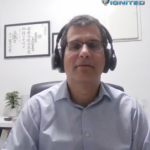
Beyond the Heat: Pioneering the Future of Extreme Environment Materials with Dr. Ed Pope
What if the biggest constraint on hypersonic propulsion and next-gen turbines isn’t the design—but whether the material can survive 2,200 to 5,000 degrees Fahrenheit in the real world?
That was the central theme of this episode of Industry Ignited, where Dr. Leeanne Aguilar sat down with Dr. Ed Pope, CEO and founder of MATEC and Super Carbon Composites Technologies (SCCT). As a world-renowned technologist in ultra-high temperature ceramics and composites, Dr. Pope brings a grounded, rigorous perspective to material science—one that challenges the common assumptions many leaders still hold about innovation in defense and aerospace.
From Academia to the Lab Floor
Dr. Pope’s journey into material science wasn’t just about research; it was about autonomy. After earning his PhD, he founded MATEC in 1989—a time when the “golden age” of large, corporate-backed research labs was beginning to fade.
Instead of staying within the confines of established institutions, he wanted the freedom to pursue breakthrough technologies that were often overlooked by the bureaucratic machinery of the era. He didn’t just want to write papers; he wanted to solve the physical limitations of flight.
The Biggest Innovation Mistake: The “Legacy Trap”
One of the most persistent myths in aerospace is that the best materials are the ones we’ve always used.
Dr. Pope sees this mindset derail progress constantly.
Despite decades of R&D investment, major prime defense contractors often exhibit a strong preference for legacy materials developed in the 1950s and 60s. Why? Because qualifying new materials is a time-intensive, high-risk, and incredibly expensive endeavor.
But as we push toward Mach 12 and beyond, the reliance on legacy materials is no longer just a hurdle—it’s a bottleneck that prevents us from achieving the next generation of performance.
Why “Perfect” Research Still Fails to Launch
Even the most scientifically sound material can fail to make it to the field.
Why?
Because of the “Valley of Death” between university-level conceptual research and the realities of production. Dr. Pope emphasizes that there are two key stakeholder groups in any material science project:
- The Researchers/Engineers, who push the boundaries of what is physically possible.
- The Procurement/Program Managers, who manage the cost and risk of integration.
Too often, the two don’t speak the same language. Dr. Pope describes his role not just as a scientist, but as a translator—ensuring that advanced material solutions are not just scientifically viable, but also manufacturable and scalable.
Start with the Problem, Not the Physics
Another common mistake? Trying to force a “cool” new material into an application where it doesn’t belong.
Leaders want to fix their biggest bottleneck, but jumping straight into complex, untested materials increases risk dramatically. Dr. Pope’s advice is simple:
- Prioritize Market Pull: Solve the specific problems industry faces—such as the need for faster, cheaper, and more durable components—rather than trying to force new tech into established workflows.
- Focus on Reusability: When evaluating candidate materials, Dr. Pope looks first at ablation resistance—how a material performs at 5,000°F—followed closely by its ability to be reused, which is vital for the future of hypersonic platforms.
Innovation Takes Time—And Strategic Patience
Material science isn’t plug-and-play.
Depending on the complexity of the ceramic matrix composite, development and qualification can take years. And even then, delays are common—whether from budget cycles or shifting political priorities.
That’s why expectation management is critical. Smart innovators build in buffer time, plan for variability, and avoid overpromising on timelines that ignore the realities of extreme environment testing.
What AI Can—and Can’t—Do (Yet)
While AI dominates industry conversations, Dr. Pope holds a pragmatic view. He sees value in AI for data management and pattern recognition, but he offers a stark warning:
- AI draws from the past: It can aggregate existing knowledge, but it cannot create the fundamental physical discoveries that come from hands-on lab work and observation.
- The “Hallucination” Factor: In high-stakes engineering, where a calculation error at 5,000°F results in catastrophic failure, AI’s tendency to “hallucinate” or provide plausible-sounding but incorrect data is a risk that cannot be ignored.
Materials Are the Boundary
Across every stage of defense innovation, one factor stands above the rest: the physical limit of the materials we use.
And those limits aren’t just overcome through better computer models; they are overcome through:
- Deep understanding of material chemistry
- Clear, honest communication with program stakeholders
- Confidence backed by decades of laboratory experience
When both the engineering teams and the decision-makers understand the true nature of these material constraints, the industry moves faster. Breakthroughs happen.
Dr. Pope’s career serves as a powerful reminder that materials aren’t just inputs; they are the boundary between what is imaginable and what is actually achievable.
Visit the podcast and listen here: https://www.buzzsprout.com/2514972/episodes/19122272
And as always—stay bold, stay curious, and keep igniting industry.
Interested in being featured on the podcast?
Contact: podcast@industryignited.com